Five to nine people. The sentence appears everywhere. Training materials. Conference talks. Certification exams. We repeat it so often that we no longer ask the simplest question: why?
After almost three decades in IT, I’ve seen teams succeed for reasons that had nothing to do with process maturity or tooling, and fail for reasons that had nothing to do with capability. In many cases, the turning point was not a new framework or a new coach. It was simply the size of the team.
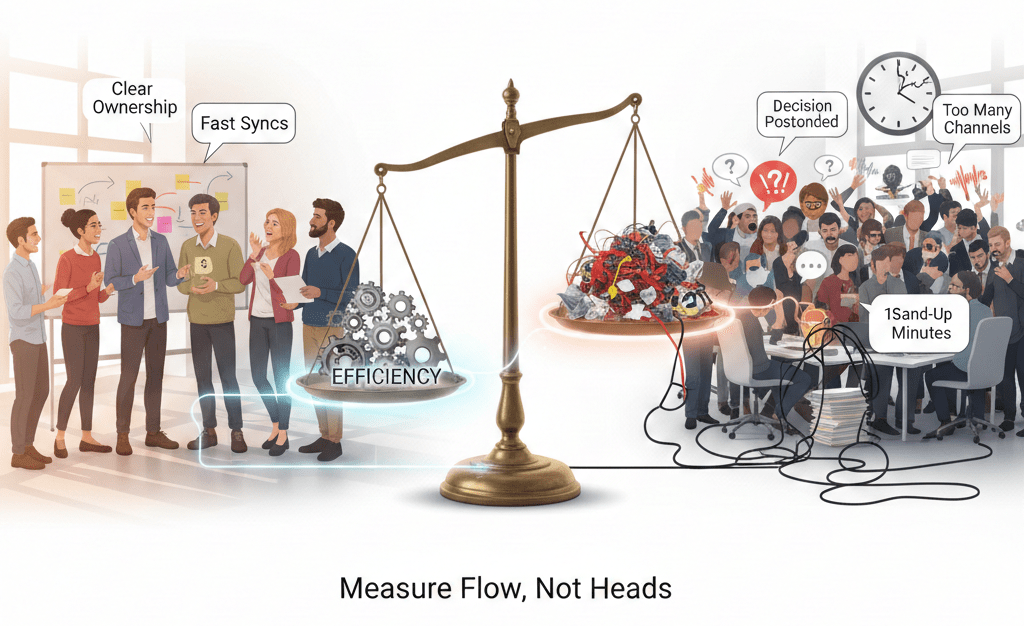
One project in particular always comes back to mind. A high-performing team slowly started to struggle. Long sprint plannings. Stand-ups with no energy. Decisions constantly postponed. Everyone assumed motivation was fading. We reduced the team by two people after a planned rotation. Two weeks later, the dynamic switched. Faster syncs. Clear ownership. Delivery regained momentum. Nothing else had changed except the size of the group.
Why the “Five to Nine” Rule Persists
So why is the famous “five to nine” range so persistent? It’s not marketing. It comes from human limits. More people means more communication channels. More channels means more alignment. Past a certain threshold, the cost of coordination quietly exceeds the value created by additional hands. Scrum, SAFe, Spotify-inspired models and most Agile variants converge on small teams for exactly this reason: flow collapses when alignment overtakes creation.
Warning Signs of Team Size Imbalance
You can feel the problem long before you can measure it, but a few visible indicators usually tell the story:
• Daily stand-ups take more than 15 minutes without real blockers
• Decisions roll from one meeting to the next because “not everyone was there”
• Stories sit in progress longer than estimates, and the team ends sprints exhausted rather than satisfied
When Teams Are Too Large
Oversized teams rarely collapse suddenly. They erode gradually. More refinement meetings. More clarification. More hand-offs. People start to work next to each other instead of with each other.
When Teams Are Too Small
The opposite extreme is just as damaging. An undersized team over-performs for a short period, then burns out quietly. Too few hands. Too many dependencies. One sick leave or one resignation becomes a crisis. Quality dips first, morale later.
Context Matters, Principles Don’t
Different contexts add complexity, but the principle stays the same:
- Distributed teams need to stay even smaller, because sync costs are higher and silence carries more risk
- Highly technical environments may require rare expertise, but clear accountability matters more than adding bodies
- Regulated industries (MiFID, DORA) require separated roles for control purposes, but compliance boundaries and delivery team boundaries are two different things
Finding Your Team’s Right Size
Whatever the flavour of Agile, whatever the label of the squad, the optimal size of a team is not defined by a certification handbook. It is defined by the stability of the flow and the ease of collaboration.
If your sprint events energise the team instead of draining it, if decisions move forward without friction, if ownership is obvious without reminders, you have probably reached the right size.
If not, the fix is rarely a new process. It is often simply the number of people in the room.
The right team size doesn’t reveal itself when you count heads.
It reveals itself when you start measuring flow.
If this resonates with challenges in your organization, whether you’re leading teams or working within them, share your experience below. The most insightful conversations often come from the field rather than from textbooks.


0 Comments